
On this page8 sections
A bricklayer builds and repairs anything made of brick, block or stone: house walls, garden walls, fences, letterboxes, steps and planters. This guide explains how bricklayers price their work, what pushes a quote up, and what to check before you hire one.
Costs to Hire a Bricklayer
Bricklayers price work in one of three ways, and the method changes what the number on the quote means.
By the hour or day. Common for small jobs: replacing a few cracked bricks, repointing a short section of wall or rebuilding a letterbox. Most bricklayers charge about $60 to $90 an hour. Ask whether there is a minimum charge and whether travel is included.
Per 1,000 bricks. The usual way to price new brickwork, such as a house, an extension or a long garden wall. The rate often covers laying only, so the bricks, mortar and scaffolding may sit on a separate line or be your job to supply.
Per square metre or as a fixed price. Used for face-brick walls, blockwork and small, well-defined jobs. A fixed price is the easiest to compare because the whole job sits in one figure.
Whichever method a quote uses, check whether it is labour only or supply and lay. Two quotes can look far apart when one includes the bricks and the other doesn't.
How Bricklayers Price Per Brick
Bricklayers tend to set a rate per 1,000 bricks rather than per brick, then scale it to your job. For standard bricks, labour usually runs about $1,000 to $2,000 per 1,000 bricks, or roughly $1 to $2 a brick. Straight runs of standard brick at a comfortable working height are the quickest work. Feature bonds, curved walls, small piers and work off scaffolding slow the bricklayer down and push the rate up.
If a quote gives a per-1,000 rate, ask how many bricks the bricklayer has allowed for the job and what happens if the count runs over. That turns a rate into a total you can budget for.
What would your job cost?
Get real quotes from local bricklayers
Describe the job in a sentence. We'll send it to verified bricklayers near you.
Free · No obligation
What factors impact the cost of hiring a bricklayer?
These are the things that usually move a bricklaying quote:
The bricks or blocks. Recycled, handmade and feature bricks can cost more to buy and take longer to lay than standard clay bricks or concrete blocks.
Height and access. Work above head height needs scaffolding. Tight side passages and sloping blocks mean materials are carried in by hand, which adds time.
Demolition and preparation. Knocking down an old wall, removing rubble and pouring new footings are separate jobs, sometimes done by other trades.
Openings and details. Windows, doors, lintels, arches and tie-ins to an existing wall take longer than a straight run of brickwork.
Repairs versus new work. Matching old bricks and mortar colour on a repair can take longer per brick than building something new.
Ask for a written, itemised quote after the bricklayer has seen the site. A quote given from photos alone is likely to change once they see the access and the ground.
Types of Jobs Done by a Bricklayer
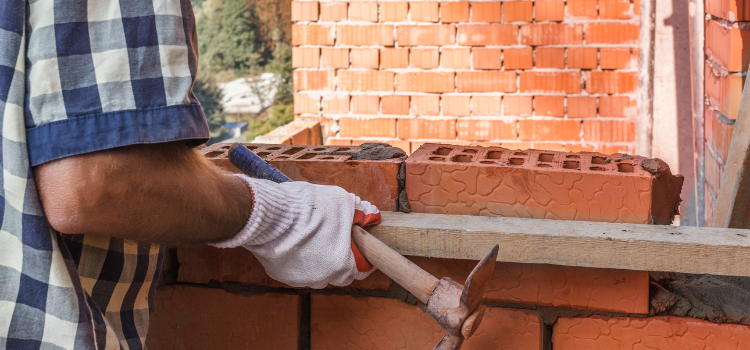
Most bricklayers take on a mix of new work and repairs:
New brick or block walls, extensions and garages
Brick fences, piers and letterboxes
Repointing, crack repairs and replacing damaged bricks
Retaining walls in brick or concrete block
Stonework, steps, planters and barbecues
Rendering is a separate trade. A bricklayer builds the wall and a renderer finishes it, so if you want a rendered wall, budget for both. For a whole extension, a builder usually manages the bricklayer along with the other trades.
Cost of Bricklaying Across Australia
Rates vary between cities and regions with local demand, travel distances and the cost of materials. Sydney rates tend to sit at the top of the hourly range, and Adelaide and many regional areas nearer the bottom. The rules also change at the state border, and they decide when you need a licensed tradie:
Rather not lose the weekend?
Compare quotes from verified bricklayers near you. Free, no obligation.
New South Wales: a contractor licence is needed for residential bricklaying worth more than $5,000 in labour and materials, including GST (NSW Government).
Queensland: bricklaying and blocklaying work worth more than $3,300 needs a QBCC licence (Australian Government licence guide).
Victoria: domestic building work worth more than $10,000 generally needs a registered builder. Confirm that the registration covers bricklaying and blocklaying (Building and Plumbing Commission).
Other states and territories set their own thresholds, so check with your state's building regulator before work starts. Retaining walls and structural brickwork often need council approval or an engineer's design as well, whatever the job is worth. Your council can tell you what applies to your block.
Choosing a Bricklayer
Before you hire, look at photos of walls the bricklayer has built, ideally in the same brick and style you want. Read their reviews and ask how long the job will take and who will be on site.
For any job above your state's licence threshold, ask for the licence number and check it on the regulator's public register. Get the scope, the price method and what's included in writing before the first brick goes down.
Tip: Ask every bricklayer to quote the same scope, the same bricks and the same price method, so you can compare the totals side by side.
Related cost guides
Prices vary by location and change with the market. Use this guide as a starting point and confirm costs with written quotes.